

From Concepts to Framework: A Journey into Understanding Corporate Practices
Introduction:
When I first heard the word “corporate,” a vivid picture immediately came to mind: offices humming with activity, men and women in suits and ties, polished shoes, expensive watches, sleek meeting rooms, and people who seemed highly experienced, disciplined and efficient. I thought of cash flow, competition, teamwork, management hierarchies, and even personality and attitude moulding.
But as I observed more, I realised that these surface impressions only hinted at the complexity beneath. I wanted to understand what truly drives corporate practices—the reasoning behind organisational decisions and how professionals shape businesses that impact people, society and the economy. This curiosity set the stage for my first step: exploring and organising the corporate landscape.
Step 1: Exploring the corporate landscape:
To make sense of corporate life, I began by compiling a repository of terms associated with it. Words like corporate social responsibility (CSR), corporate sustainability, corporate governance, corporate innovation, corporate communications, corporate accountability corporate fraud research, corporate environmental performance and corporate political strategy reflected the diversity of corporate functions and priorities.This exercise helped me see that corporate practices aren’t random—they form clusters of related activities, each with its own focus and purpose.
From this analysis, I identified seven key corporate domains that seemed to capture the full spectrum of corporate operations:
Ethics, responsibility & accountability
Sustainability & environmental focus
Governance, power & political influence
Strategy, structure & decision-making
Performance, reporting & transparency
Innovation, knowledge & growth
Communication & digital presence
Having identified these domains, I realised that understanding them fully required a theoretical lens to explain why organisations act the way they do.
Step 2: Linking practice to theory:
I turned to three core management theories to interpret the patterns I had observed:
● Stakeholder Theory: Organisations must balance the interests of all stakeholders affected by their actions, not just shareholders (Mahajan et al., 2023).
● Legitimacy Theory: Organisations maintain societal approval by aligning actions with norms and expectations (Dziak, 2023).
● Agency Theory: Organisations face inherent conflicts between owners and managers, requiring governance and oversight mechanisms (Elsevier, n.d.).
Mapping the corporate domains to these theories allowed me to see the reasoning behind each practice. CSR initiatives and sustainability projects addressed stakeholders while enhancing societal legitimacy. Governance structures and reporting mechanisms helped resolve principal–agent conflicts. This theoretical perspective transformed my understanding from mere observation to a structured, analytical view of corporate life.
With theory in hand, the next challenge was to combine these insights into a coherent, actionable framework.
Step 3: Developing the Conceptual Framework:
I developed a conceptual framework that links corporate domains to their theoretical lenses. The framework shows how practices like innovation programs, environmental reporting, or social media engagement can simultaneously satisfy stakeholders, align with societal expectations, and manage managerial accountability.
For example, a sustainability report not only communicates environmental performance to stakeholders but also demonstrates legitimacy in the eyes of the public while reducing information asymmetry between managers and owners (Priyanto & Ri Esso, 2025). Similarly, innovation initiatives provide value to stakeholders and equip teams to achieve organisational goals effectively (Planview, n.d.).
The framework presented here emerged from a shift in perspective—from viewing the corporate world as a set of visible structures and roles to understanding it as a system shaped by accountability, ethics, and stakeholder relationships. These theories help explain why corporate decisions matter beyond operational outcomes.
Rather than serving as a rigid model, this framework acts as a practical lens for understanding how organisations create value, maintain legitimacy, and manage relationships in contemporary corporate environments. It is intended to support reflection and informed decision-making for students and professionals navigating the modern corporate landscape.
Framework:
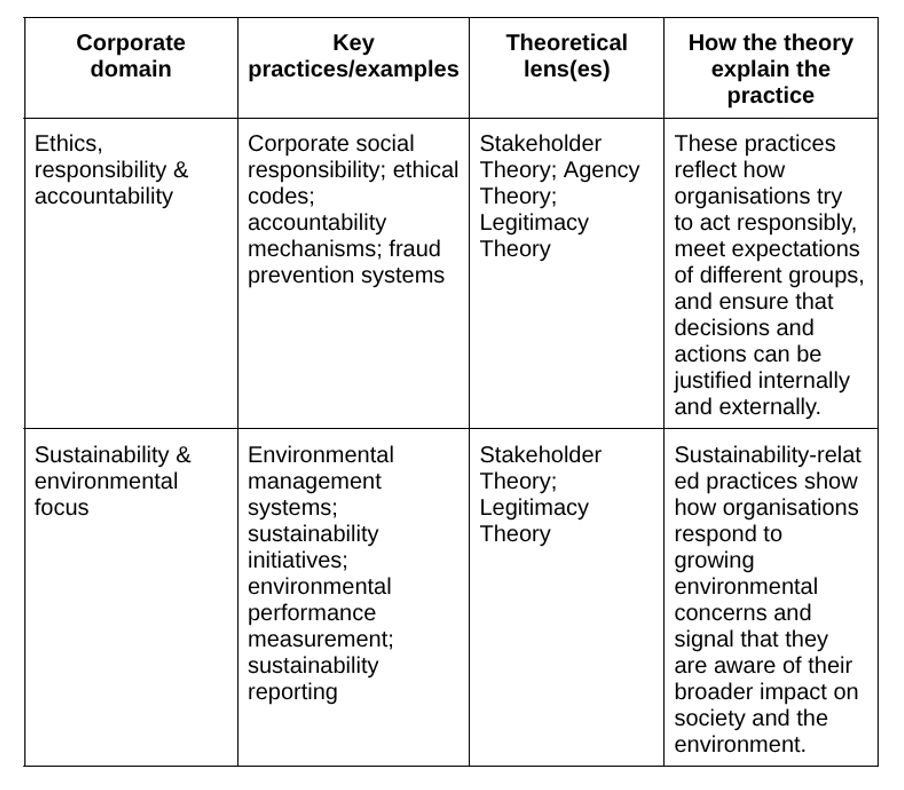
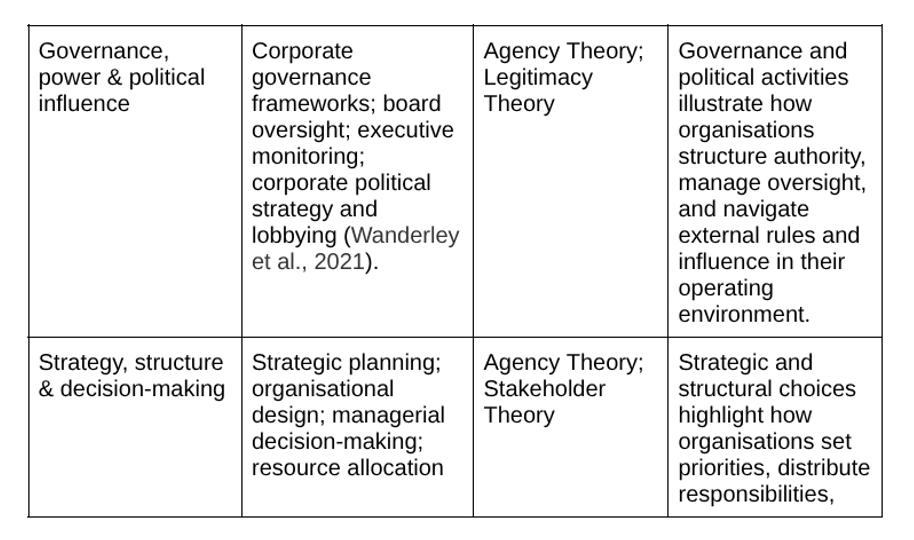
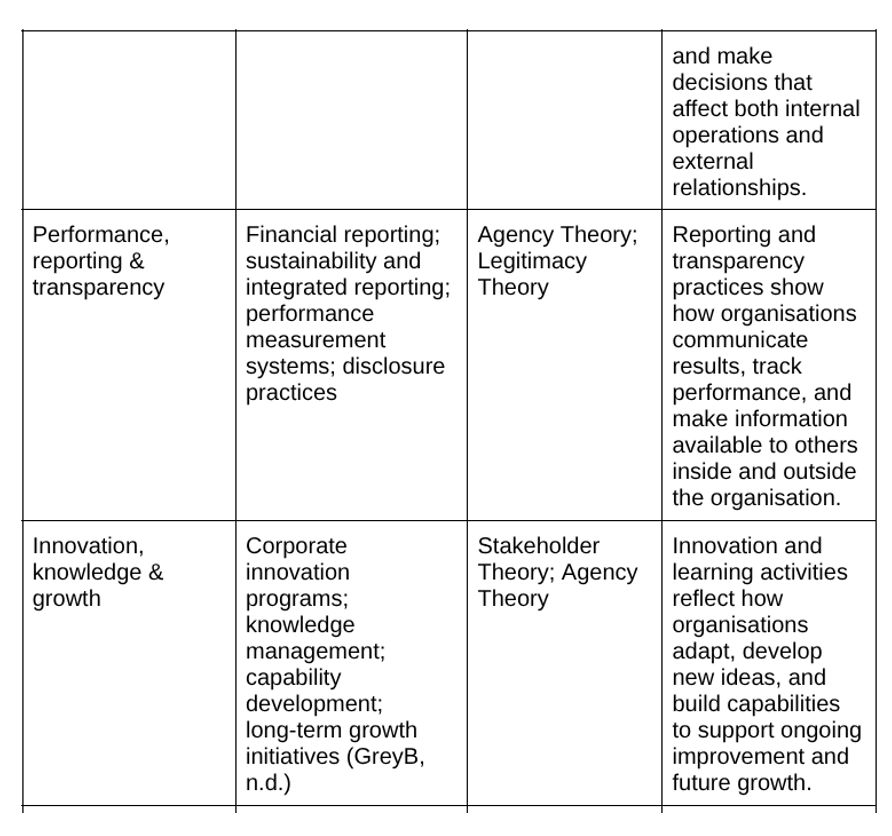
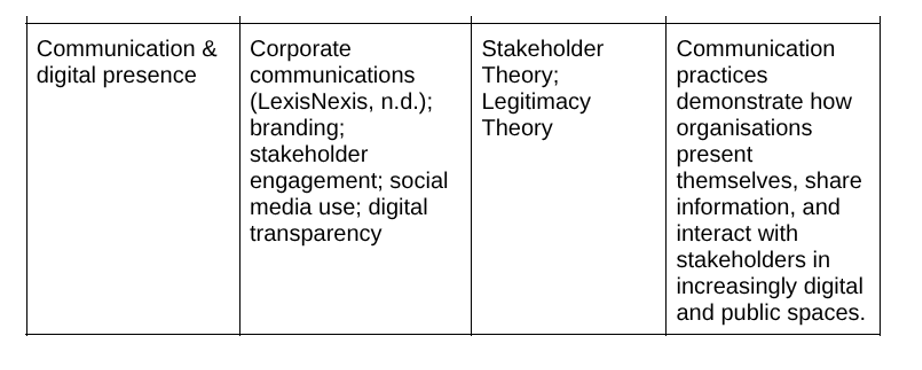
Creating this framework was a turning point, but it also led me to reflect on the personal journey behind its development. Having developed this framework as a way of organising and interpreting corporate practices, the next step is to consider how it might be used in practice. Rather than remaining a purely conceptual model, the framework opens up opportunities for reflection and application in learning and professional contexts.
Step 4: Potential applications of the framework:
This framework can be used as a practical thinking tool for students and early-career professionals trying to make sense of the corporate environment. Rather than viewing corporate practices as isolated activities, the framework encourages a more holistic way of understanding how different domains—such as governance, sustainability, innovation, and communication—interact with one another. For students, it offers a structured way to analyse case studies, coursework, or workplace experiences by helping identify which corporate domain is most visible and how it connects to broader organisational priorities. For professionals, the framework can support reflection on everyday decisions, such as how reporting choices, stakeholder communication, or sustainability initiatives fit within the wider organisational context. More broadly, it provides a flexible lens for interpreting corporate behaviour, allowing individuals to move beyond surface-level observations and develop a more informed and critical understanding of how organisations operate in practice.
Conclusion:
This article traced my journey from an initial, surface-level perception of the corporate world to a more structured and reflective understanding of corporate practices. What began as an image of suits, offices, and hierarchies gradually evolved into an appreciation of the interconnected systems that shape organisational behaviour. By exploring key corporate concepts, linking them to established theories, and developing a conceptual framework, I was able to move beyond observation and towards interpretation.
The framework does not attempt to define how organisations should operate. Instead, it offers a way of thinking about why certain practices exist and how they relate to one another within the broader corporate landscape. Through this process, I came to see corporate life as a dynamic environment shaped by accountability, stakeholder relationships, and ongoing adaptation rather than a fixed set of roles or rules.
Ultimately, this journey reinforced the value of stepping back and critically engaging with everyday organisational practices. For students and emerging professionals, developing this kind of reflective lens can support more informed learning, decision-making, and engagement with the corporate world as it continues to evolve.
References
Alyahya, M., & Agag, G. (2025). How Does Corporate Environmental Performance Contribute to Firm Performance and Customer Satisfaction? A Longitudinal Investigation. Sustainability, 17(4), 1644. https://doi.org/10.3390/su17041644
Australian Institute of Company Directors. (2023). What is corporate governance? https://www.aicd.com.au/corporate-governance.html
Dziak, M. (2023). Legitimacy theory. EBSCO Research Starters. https://www.ebsco.com/research-starters/business-and-management/legitimacy-theory
Elsevier. (n.d.). Agency theory. ScienceDirect Topics. https://www.sciencedirect.com/topics/social-sciences/agency-theory
Fernando, J. (2025, December 30). Corporate Social Responsibility (CSR): What it is, how it works, and types. Investopedia. https://www.investopedia.com/terms/c/corp-social-responsibility.asp
Go, W. (2025, September 5). Corporate Sustainability: Definition and Benefits. Presgo. https://www.presgo.com/articles/corporate-sustainability/#What_is_corporate_sustainability
GreyB. (n.d.). What is corporate innovation? GreyB. https://greyb.com/glossaries/corporate-innovation/
Chen, J. (2022, July 13). Corporate accountability: Definition, examples, importance. Investopedia. https://www.investopedia.com/terms/c/corporate-accountability.asp
LexisNexis. (n.d.). Corporate communications. LexisNexis Glossary. https://www.lexisnexis.com/en-us/professional/media-intelligence/glossary/corporate-communications.page
Mahajan, R., Lim, W. M., Sareen, M., Kumar, S., & Panwar, R. (2023). Stakeholder theory: A systematic literature review. Journal of Business Research, 166, Article 114104. https://doi.org/10.1016/j.jbusres.2023.114104
Planview. (n.d.). Strategic innovation and why it’s important. https://www.planview.com/resources/guide/strategic-planning-deliver-value/strategic-innovation-and-why-its-important/
Priyanto, H. B., & Ri Esso, A. S. (2025). Analyzing the role of sustainability reporting in enhancing corporate image and shareholder value. Riwayat: Educational Journal of History and Humanities, 8(4), 5614–5622. https://www.researchgate.net/publication/396543138_Analyzing_the_Role_of_Sustainability_Reporting_in_Enhancing_Corporate_Image_and_Shareholder_Value
UWA Research Impact. (n.d.). Catching corporate fraud: A systems intentionality approach. The University of Western Australia. https://researchimpact.uwa.edu.au/research-impact-stories/catching-corporate-fraud-a-systems-intentionality-approach/
Wanderley, C. de A., Cullen, J., & Tsamenyi, M. (2021). Corporate political strategy: the roles of management accounting in relational work. Accounting Forum, 45(2), 200–226. https://doi.org/10.1080/01559982.2020.1848321