

Becoming A Professional in My Field: Understanding Future Challenges
*As a business student I've, through this article, shown how one can research into how AI may affect reader’s careers. This article is not relevant to my own career and is to be used as a research guide only, learnt from the unit Professional Evidence.*
Recent technological advancements, particularly in artificial intelligence (AI) and automation, are rapidly refining the nature of work. This is creating both opportunities for productivity growth and challenges related to inequality, job disruption and workforce adaptation. This essay looks at examples not just within Australia but refers to situations in the U.S, Canada, Palestine and Germany to showcase how AI and automation impacts globally.
Part 1
A- Transformation of future of work
Nature of AI impact (augmentation vs disruption)
As Gallego & Kurer (2022) puts it, new technologies have been a key driver of business growth and productivity. For instance, the Australian Parliamentary report (Parliament of Australia, n.d.) demonstrates how Artificial Intelligence (AI), particularly Generative AI (GenAI), is rapidly being adopted across industries to automate tasks and enhance decision-making. From a management’s perspective, this aligns with arguments that AI is enabling data-driven organisations, improving efficiency, innovation and competitive advantage. The report’s estimate that AI could contribute $115 billion to the Australian economy by 2030 (around 5% GDP growth) illustrates how technological change is not just operational but strategic. The report supports the perspective that AI is primarily augmenting jobs rather than fully replacing them (Parliament of Australia, n.d.). This aligns with management theories of complementarity, where technology enhances human capabilities instead of substituting them entirely (Richard, 2005). The report highlights how employees are already independently integrating AI tools into their workflows, often without formal organisational strategies (Parliament of Australia, n.d.).
Task transformation and human-AI collaboration
The article by Fugener et al. (2025) highlights how AI is transforming work through both automation (replacing human tasks) and augmentation (supporting human work). This demonstrates a key shift in business and management, where AI is becoming a standard component of organisational operations. The study further talks about how AI enables a hybrid model of work rather than fully replacing workers. The authors suggest that tasks are allocated based on competitive strengths such as:
AI performing routine and data-driven tasks;
Humans handling complex, creative, and strategic activities;
Shared tasks involving human-AI collaboration.
Further studies such as Tschang & Almirall (2021) highlights the significant impact of AI and automation on the labour market, suggesting that up to 47% of jobs in the U.S. may be at risk. This showcases the scale of technological change within business and management, where AI is both augmenting and replacing human tasks. A key contribution of the article is its discussion of the “hollowing out” of middle-skilled jobs, where demand increases how AI is transforming business operations and employment simultaneously. In the article, the example of Amazon creating 300,000 jobs while doubling its use of robots highlights that automation does not simply reduce employment but reshapes it.
Business operations and functional impacts
AI is driving significant technological change in Human Resource Management (HRM) by automating repetitive tasks such as recruitment, payroll, data analysis, and performance management (Rayhan, 2023). The authors discuss that organisations can:
Analyse employee data to improve performance;
Predict staff turnover and workforce trends;
Deliver personalised training and development programs/
The statistics shared in the study suggest that 92% of HR professionals foresee to increase its usage in some form. Despite these benefits, Rayhan’s work emphasised that AI cannot fully replace human judgement and emotional intelligence, which remain critical in HRM (Rayhan, 2023).
An example highlighting the growing role of AI in transforming organisational decision-making and risk management could be seen in the Palestinian banking sector. It demonstrates how AI enables automation of risk processes, real-time risk detection and enhanced data-driven decision-making (Tanbour et al., 2025). The study shows that organisations are using AI to improve efficiency, accuracy in processes, and risk management outcomes, particularly in credit and operational risk. It demonstrates this by showing that banks use AI-driven models to automate credit assessment, detect anomalies in transactions, and continuously monitor operational processes in real time. In credit risk, AI improves efficiency and accuracy by analysing large volumes of customer and financial data to generate more precise risk scores and faster lending decisions, while in operational risk it enhances outcomes through early detection of fraud, process failures, and compliance breaches, thereby reducing human error and response times (Tanbour et al., 2025).This portrays how AI adds value by reducing human error and improving performance, making it a critical tool in modern business operations. However, the study also provides a balanced perspective, noting that AI is less effective in areas like market risk, mainly due to limited technology infrastructure and lack of specialised expertise.
A publication by Quaquebeke & Gerpott, (2023) highlights how AI is driving major technological change in leadership and management, extending beyond routine automation to include complex managerial functions such as decision-making, analysis and coordination. Despite its capabilities, the article emphasises that AI cannot fully replace human leadership qualities such as:
Motivation and inspiration;
Ethical judgement;
Emotional intelligence.
This highlights the continuous importance of human-centred leadership, where managers provide vision, empathy and interpersonal understanding where AI remains limited.
This supports the argument in business and management literature that the future of leadership involves collaboration between human leaders and AI, rather than full replacement.
Demographic change and structural pressures
A German conference paper Naujoks et al. (n.d.) highlights that demographic change, particularly ageing populations and declining workforce participation, is a major driver of the future of work. The Fraunhofer report (Naujoks et al., n.d.) reinforces this by showing how Germany’s working-age population is projected to decline from 43.3 million in 2020 to 38 million by 2040, intensifying structural skill shortages. The report demonstrates that these pressures are accelerating the adoption of AI and automation, suggesting that technological changes are not occurring in isolation but are directly shaped by demographic trends. The report highlights a key trend in management literature: the shift from human-intensive to technology-assisted work systems. It predicts that the proportion of tasks performed solely by humans will decline from 47% in 2025 to 34% by 2030, (Naujoks et al., n.d.) showing rapid technological integration.
Lastly, The Demographics of Automation in Canada by Frenette & Frank (2020) explains how AI and automation are transforming the labour market and employment structures, using Canada as a key example. It highlights major technological change, showing that AI is not necessarily replacing entire jobs but is instead changing job tasks and requiring workers to develop new skills. The report provides important statistics, such as over 10% of Canadian workers being at a high risk of job transformation, with around 30% at moderate risk, demonstrating the large impact of automation on the workforce. In terms of business operations, this means organisations must adapt by redesigning roles, adopting new technologies, and investing in employee training to remain competitive. The article also highlights demographic impacts, showing that workers with lower levels of education are more vulnerable to automation, while higher-skilled workers are more likely to benefit from new AI-related opportunities. This suggests that AI may increase inequality if not managed effectively. Overall, the study showcases how AI is reshaping the workforce in Canada by changing job requirements, increasing the need for skill development and forcing businesses to adapt to technological change.
B- Potential implications of these transformations
The analysis conducted so far covers 10 major types of AI transformations including:
augmentation,
task restructuring,
labour market shifts,
human-AI collaboration,
functional automation,
decision-making transformation,
leadership evolution,
demographic-driven change,
skill transformation, and
inequality effects.
The potential implications of these transformations will now be discussed.
Employment opportunities
As seen in Rayhan (2023) & Tanbour et al. (2025) AI is likely to re-shape rather than eliminate jobs, with automation replacing routine tasks while creating new roles in areas like AI development, data analysis and system management. There will be job polarisation, with growth in high-skilled and some low-skilled roles, and decline in middle-skilled jobs. Employment may shift toward smaller, more specialised teams, as AI increases productivity and reduces labour demand per task (Rayhan, 2023). Tanbour et al. (2025) discusses that in sectors facing labour shortages (e.g. ageing populations), AI can support workforce gaps rather than replace workers.
Skills requirements
Tanbour et al. (2025) states an increasing demand for AI literacy, data skills, and digital capabilities across most occupations. Rayhan (2023) talks about a shift toward non-routine, cognitive and inter-personal skills such as creative, problem-solving and communication. Workers need to develop hybrid skills to collaborate effectively with AI systems. Continuous reskilling and upskilling become essential due to evolving job roles and technological change (Tanbour et al., 2025).
The workplace environment
At the ground level, AI is fundamentally changing what it feels like to be at work. We are moving toward a truly collaborative workplace where humans and software share the workload based on what each does best (Frenette & Frank, 2020). But this shift brings a distinct push-and-pull. On one hand, using AI for monitoring and data analytics makes operations incredibly efficient; on the other hand, it can make employees feel micro-managed and strip away their independence (Rayhan, 2023). Our roles are shifting away from everyday task execution and moving toward supervision, coordination, and handling the unique problems the tech can't solve (Tanbour et al., 2025). This rise of "algorithmic management" introduces some heavy questions about workplace surveillance and overall job quality (Rayhan, 2023). It reminds us that while efficiency is great, it shouldn't come at the cost of human autonomy.
Indigenous Australians
AI and automation are likely to have uneven impacts on Indigenous Australians, largely because of existing structural inequalities. Indigenous communities already experience exclusion due to automation. For example, automation in the mining sector as discussed by (Kemp & Holcombe, 2019) showcases how they are disadvantaged. For example, automation in the mining sector, as discussed by Kemp and Holcombe (2019), demonstrates how Indigenous Australians may be disadvantaged. The shift towards remote and highly automated operations reduces the availability of on-site, entry-level, and manual jobs that Indigenous workers have traditionally relied upon. These new roles are often relocated to urban control centres and require advanced technical and digital skills, which many Indigenous communities have limited access to due to educational and training gaps. As a result, local employment opportunities may decline, reducing economic participation and potentially reinforcing existing socioeconomic inequalities. They also face a significant digital inclusion gap, with lower access to technology, connectivity and digital skills, creating a risk that this divide will extend into an “AI divide” as these technologies become more widespread (Turner, 2025). This increases vulnerability to labour market disruption, as these structural disadvantages limit access to emerging opportunities and adaptation pathways (Turner, 2025). At the same time, research shows that Indigenous peoples are often cautious about AI, expressing low trust due to concerns about lack of accountability, transparency and fairness in automated systems (Macquarie University, 2026). These concerns reflect the fact that AI systems are not neutral and may reinforce existing inequalities, particularly in areas such as welfare, healthcare and government decision making (Macquarie University, 2026). However, AI also presents potential benefits, such as improving access to services and opportunities in remote communities, if implemented appropriately (Turner, 2025). Overall, the impact of AI will depend on inclusive governance, with strong emphasis on Indigenous data sovereignty and community-led approaches to ensure that technology supports self-determination rather than deepening disadvantage (Turner, 2025).
Part 2- Personal reflection and application
The analysis conducted in the first part of this essay helped identify the changes in the workplace due to AI and automation. The changes will strongly affect my future career in Business (Management) over the next 5-10 years. As AI starts doing routine tasks, management jobs will focus more on decision-making, planning and supervising work. This means I will need to learn digital and analytical skills to work with AI tools. At the same time, human skills like communication, leadership, and emotional intelligence will become more important because AI cannot replace them. These changes also mean I will need to keep learning new skills throughout my career.
To deal with changes, it is important to use clear career planning strategies that connect long-term goals with current actions. To do that, I will utilise important frameworks and professional standards such as SMART goals setting, Tiered Goal Structure, SWOT analysis, etc. As Using Smart Goals Effectively (2024) suggests that goals act as a guide toward our ambitions, providing direction for our actions. However, without an effective framework, they remain distant aspirations rather than achievable outcomes.
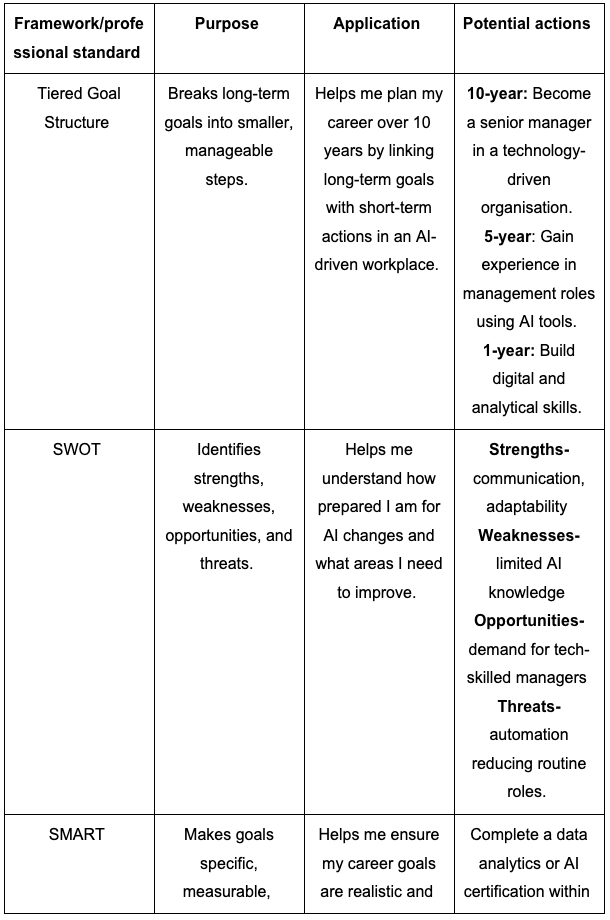
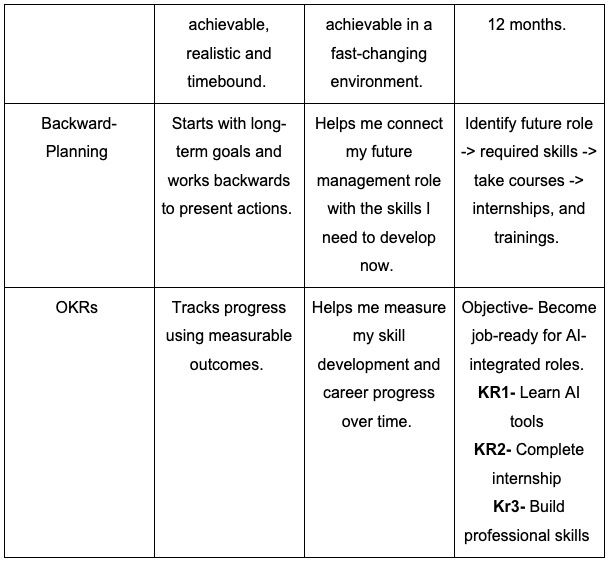
To effectively develop my personal action plan, I’ve shortlisted a few frameworks and professional standards as follows:
Tiered Goal Structure (20 Things About Tiered Goal Setting, n.d.)
SWOT analysis (Australian Government, n.d.)
SMART Goals (Monash University, n.d.)
Backward-Planning (Mindtools Membership, 2024)
OKRs- Objectives and Key Results (Panchadsaram, n.d.)
Personal action plan:
Break-down
The personal action plan developed above provides a structured approach to preparing for the future of work shaped by AI and automation. By using the Tiered Goal Structured, I am able to break my long-term career goal of becoming a senior manager into smaller, achievable steps, ensuring steady progress over time. The SWOT analysis helps me understand my current position by identifying my strengths, such as communication and adaptability, while also recognising weaknesses like limited AI knowledge that I need to improve. The SMART framework ensures that my goals are clear and measurable, such as completing a data analytics or AI related certification within a specific timeframe. Backward planning further strengthens my approach by linking my future career goals with the skills and experiences I need to develop now, including internships and training opportunities. Additionally, using OKRs allows me to track my progress by setting clear objectives and measurable results, keeping me focused and accountable. Overall, this action plan helps me stay organised, continuously improve my skills, and adapt to the changing demands of an AI-driven business environment.
Conclusion
This essay has demonstrated that artificial intelligence and automation are significantly transforming the future of work across global contexts, including Australia, the United States, Canada, Palestine and Germany. These technologies are not only improving productivity and efficiency but also reshaping job roles, skill requirements, and organisational structures. While AI is largely augmenting rather than replacing jobs, it creates challenges such as skill gaps, job polarisation, and increasing inequality. The analysis also highlights the continued importance of human skills such as leadership, communication,and ethical judgement, especially in management roles. From a personal perspective, these changes will directly impact my future career in Business (Management), requiring me to develop both digital and inter-personal skills to remain competitive. By applying structured planning frameworks such as Tiered Goal Structure, SMART goals, SWOT analysis, backward planning, and OKRs, I can create a clear and adaptable career pathway. Overall, successfully becoming a professional in my field will depend on my ability to continuously learn, adapt to technological change, and effectively combine human capabilities with emerging technologies in a dynamic work environment.
References
Mental Health Activity. (n.d.) 20 Things About Tiered Goal Setting. Mental Health Activity. https://www.mentalhealthactivity.com/tiered-goal-setting/
Australian Government. (2025). Our Gen AI Transition- Implications for Work and Skills. Jobs and Skills Australia. https://www.jobsandskills.gov.au/publications/generative-ai-capacity-study-report
Australian Government. (n.d.). Do a SWOT analysis. Australian Government. https://business.gov.au/planning/business-plans/do-a-swot-analysis
Frenette, M., & Frank, K. (2020). The demographics of automation in Canada: Who is at risk?. Montreal: Institute for Research on Public Policy, (77). https://ezproxy.canberra.edu.au/login?url=https://www.proquest.com/reports/demographics-automation-canada-who-is-at-risk/docview/2429070341/se-2
Fugener, A., Walzner, D.D., & Gupta, A. (2025). Roles of Artificial Intelligence in Collaborations with Humans: Automation, Augmentation, and the Future of Work. Management Science. 72(1), 538-557. https://doi.org/10.1287/mnsc.2024.05684
Gallego, A., & Kurer, T. (2022). Automation, Digitalization, and Artificial Intelligence in the Workplace: Implications for Political Behaviour. Annual Review of Political Science, 25(2022), 463-484. https://doi.org/10.1146/annurev-polisci-051120-104535
Holcombe, S., & Kemp, D. (2019). Indigenous peoples and mine automation: An issues paper. Elsevier, 63. https://doi.org/10.1016/j.resourpol.2019.101420
Macquarie University. (2026, Apr 23). ‘No accountability, no checks and balances, no responsibility’: how indigenous peoples think about AI. Macquarie University The Lighthouse. https://lighthouse.mq.edu.au/article/2026/april-2026/how-indigenous-peoples-think-about-ai
Monash University. (n.d.). What is a SMART goal?. Student Academic Success. Student Academic Success. https://www.monash.edu/student-academic-success/excel-at-writing/annotated-assessment-samples/pharmacy-and-pharmaceutical-sciences/pps-reflective-writing/what-is-a-smart-goal
Mindtools Membership. (2024, May 21). Leap Forward With Backward Goal Setting. Mindtools Membership. https://www.mindtools.com/actal93/leap-forward-with-backward-goal-setting/
Naujoks, T., Zaccaria, M., Beinhauer, W., & Rief, S. (n.d.). Fraunhofer IAO. https://publica-rest.fraunhofer.de/server/api/core/bitstreams/86142a38-3881-44ce-bee0-b339174d2f5d/content
Parliament of Australia. (n.d.). Chapter 4- Impacts of AI on industry, business and workers. Parliament of Australia. https://www.aph.gov.au/Parliamentary_Business/Committees/Senate/Adopting_Artificial_Intelligence_AI/AdoptingAI/Report/Chapter_4_-_Impacts_of_AI_on_industry_business_and_workers
Panchadsaram, R. (n.d.). What is an OKR? Definition and Examples. What Matters. https://www.whatmatters.com/faqs/okr-meaning-definition-example
Quaquebeke, N. V., & Gerpott, F. H. (2023). The Now, New, and Next of Digital Leadership: How Artificial Intelligence (AI) Will Take Over and Change Leadership as We Know It. Journal of Leadership & Organizational Studies, 30(3), 265-275. https://doi.org/10.1177/15480518231181731
Rayhan, J. (2023). Artificial Intelligence (AI) in Human Resource Management (HRM): A Conceptual Review of Applications, Challenges and Future Prospects. GMJ, 17(1), 37-52. https://research-ebsco-com.ezproxy.canberra.edu.au/c/aprr63/viewer/pdf/6bmrlye3sn
Richard, D. (2005). Complementarity and institutional change: How useful a concept? Econstor. https://www.econstor.eu/bitstream/10419/51225/1/507315529.pdf
Tschang, F.T. & Almirall, E. (2021). Artificial Intelligence Augmenting Automation: Implications for Employment. Academy of Management Perspectives.35(4), 642-649. https://research-ebsco-com.ezproxy.canberra.edu.au/c/aprr63/viewer/pdf/4cufsxyruj?route=details
Tanbour, K.M., Saada, M.B., Nour, A.I., & Elnass, N.K. (2025). Integrating Artificial intelligence into risk management frameworks: a mixed-methods analysis of the Palestinian banking sector. Journal of Financial Reporting & Accounting. 1-42. https://doi-org.ezproxy.canberra.edu.au/10.1108/JFRA-06-2025-0458
Turner, K. (2025). The Future Impact of Artificial Intelligence on First Nations Communities: Opportunities and Risks. Australian Policy Online. https://apo.org.au/node/333026
Using Smart Goals Effectively. (2024). Foundation for Professional Development (FPD). https://www.foundation.co.za/news/102/Using-Smart-Goals-Effectively/1